


January 14, 2026
How to fully uninstall Paragon NTFS for Mac


Share


Ah, NTFS for Mac. That’s a name that takes me straight back to the early 2010s. I was tinkering with my first Hackintosh build on an Intel PC and wasn’t quite ready to go “all-in” on macOS. I kept a Windows system on that machine, and Paragon was the magic bridge that let me access all my Windows drives.
It’s still a fantastic solution if you’re running a dual-boot setup or constantly swapping external drives with Windows machines. But what happens when Windows is no longer part of your “machine park”?
That’s when Paragon goes from being a vital tool to just… digital clutter. And because it’s a deep-level system driver, simply dragging the app to the Trash isn’t enough. It will leave behind hidden files and kernel extensions.
In this guide, I’ll show you how to uninstall NTFS for Mac by Paragon Software completely, so you can remove every last trace and keep your Mac clean and tidy.
This Article Contains
Before we start
A quick note for those who (like me) value their time: if you’d rather skip the digital detective work of digging through system folders, there’s a much faster way.
What’s NTFS for Mac, and why delete it
First, a quick refresher: NTFS for Mac is a file system driver. In plain English, it’s a translation tool that lets your Mac fully read and write files to Windows-formatted NTFS drives.
It’s been a lifesaver if you’re in a mixed-OS world for literally decades (here’s a 15-year-old thread about NTFS for Mac uninstallation on superuser.com!).

But, like any specialized tool, you might not need it forever. If you’re thinking about removing it, you’re probably in one of these camps:
- You’ve moved on from Windows. This is the most common reason. Like me, you’ve fully transitioned to Mac and no longer have any NTFS drives to manage.
- A macOS update broke it. This is a major headache. A new macOS version can (and often does) break the driver, suddenly mounting your drives as “read-only” or not at all. This leaves you waiting for Paragon to release a patch.
- You’ve found an alternative. Many users (myself included) now just reformat external drives to exFAT. It works perfectly on both macOS and Windows right out of the box, no extra drivers needed.
- The license is a hassle. It’s paid software, and new versions often require a new purchase. Users also report licenses breaking after an update or issues with bundled “free” versions not working as advertised.
- It’s just digital clutter. It’s an app you don’t use, and as we’re about to see, it’s not the easiest thing to just throw in the Trash.
Long story short, it’s a typical story to remove Paragon’s NTFS for Mac if you don’t need it anymore.
The 3 main methods of uninstalling NTFS for Mac
When it comes to removing Paragon’s NTFS for Mac, you have three main paths. Why three? Because this app is a deep-level system driver, simply dragging it to the Trash won’t work, and even its own uninstaller doesn’t finish the job.
These methods vary greatly in difficulty and, most importantly, in how completely they remove the app’s hidden files.
To help you pick the right method, here’s a quick comparison:
| Method | Easiness | Time to Complete | Thoroughness |
|---|---|---|---|
| Official Uninstaller | ★★☆ Medium |
Fast (Approx. 5 mins) |
Leaves behind hidden files |
| Manual Uninstallation | ★☆☆ Difficult |
Slow (10-15 mins+) |
Removes most files |
| App Cleaner & Uninstaller | ★★★ Very Easy |
Very Fast (Approx. 2-3 mins) |
Removes all files if SIP protection is disabled |
Pick the one you prefer most and scroll down to follow it step by step.
How to uninstall NTFS for Mac: The official way
This method starts by using the uninstaller provided by Paragon Software. As you’d expect, this is the “official” way to remove the app.
However, based on our testing, this method is incomplete. The uninstaller removes the main application, but it consistently leaves behind numerous service files, cache folders, and, most importantly, protected kernel extensions.
Here’s the two-part process: first, you run the official uninstaller, then you manually hunt down the files it missed.
Part A: Run the official uninstaller
You can launch the uninstaller using one of these three paths. (All three do the same thing).
Path 1: From the original .dmg file
If you still have the .dmg (disk image) you used to install the app:
- Find and double-click the ntfsmac.dmg file.
- In the installer window, double-click the Uninstall NTFS for Mac icon.
- Follow the on-screen prompts to proceed.
Path 2: From the app’s Settings menu
If you no longer have the .dmg file, you can run the uninstaller from the app itself:
- Open NTFS for Mac from your Applications folder.
- In the menu bar at the top of your screen, click NTFS for Mac → Settings….
- Click the Uninstall… button and confirm the uninstallation. You might need to click the lock to make this button clickable.
- Confirm your intention, and the app will be removed.


Path 3: Using the Terminal
This path simply launches the same uninstaller script, but from the command line:
- Go to Applications → Utilities and open Terminal.
- Copy and paste the following command exactly, then press Enter:
sudo /Library/Application\ Support/Paragon\ Software/com.paragon-software.ntfs.uninstallCopy
- Enter your macOS password when prompted (you won’t see it as you type) and press Enter. This will perform the uninstallation process.


Part B: Manually remove the leftover files
After the uninstaller finishes, it’s time to clean up the files it left behind.
Note:
We confirmed these leftover files still exist after using the uninstaller on macOS 26.0 with Paragon’s NTFS for Mac v17.0.364.
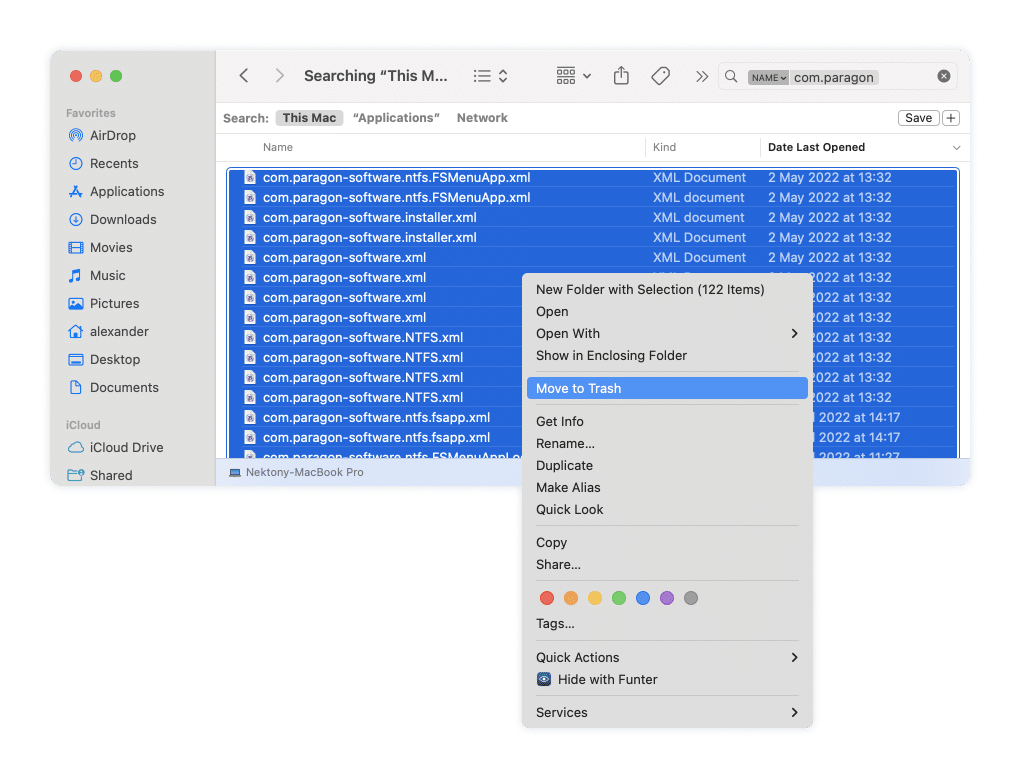
- Open Finder.
- In the search bar, type and select Search: This Mac.
com.paragonCopy

- Click the + button below the search bar and set the filter to Name Contains com.paragon.
- Select all the files and folders that appear and drag them to the Trash.

- Repeat this search-and-delete process for the following terms:
ParagonNTFSCopy
ufsd_NTFSCopy



Now for the most important part. The searches above still won’t find the core kernel extension (.kext) files, as they are in protected system locations.
Warning: SIP-Protected Files
Even after this cleanup, the uninstaller leaves behind deep-level kernel extensions. These files are protected by your Mac’s System Integrity Protection (SIP).
You can find them at these paths (you can’t delete them from here):
/Library/StagedExtensions/Library/Extensions/ufsd_NTFS.kextCopy
- (the … is a folder with a unique name)
/private/var/db/KernelExtensionManagement/AuxKC/CurrentAuxKC/StashedExtensions/…/ufsd_NTFS.kextCopy
To delete these, you would have to temporarily disable SIP, which is a complex and risky process that we don’t recommend for most users. This is the biggest reason the “official” uninstaller is incomplete.
How to uninstall NTFS for Mac: The manual way
This is the classic, hands-on approach: you’ll quit the app, drag it to the Trash, and then manually hunt down all the service files it has scattered across your system folders.
While we manually tested this method, the approach is also confirmed by other users’ suggestions, for instance, on Github.
You’ll notice this “scavenger hunt” is nearly identical to Part B of the previous method. That’s because whether you use the official uninstaller or just trash the app, the same leftover files remain. Our system-wide search will find them all, even if there are a few extra ones this way.
Note:
This process was tested and confirmed on macOS 26 running NTFS for Mac v17.0.364 but should work on all versions of macOS starting with macOS 10.12.
Step 1. Quit all Paragon processes
Before you can delete the app, you need to make sure nothing is running in the background.
- Open Activity Monitor (from Applications → Utilities).
- In the search bar, type .
ntfsCopy
- Select any active processes related to Paragon and click the “X” button in the toolbar to Stop (or Force Quit) them.
Step 2. Move the app to the Trash
- Go to your Applications folder.
- Find NTFS for Mac and drag it to the Trash.


Step 3. Hunt for the leftover service files
Now, let’s find the files the app left behind.
- Open Finder.
- In the search field (top-right of the window), type .
com.paragonCopy
- You’ll see a small filter bar appear under the search. Click on “This Mac” to make sure you’re searching your entire system, not just your home folder.
- You may need to add a filter. Click the “+” button, select Name, then Contains, and type .
com.paragonCopy
- Review the list of files and folders. Select all of them and move them to the Trash.

- Repeat this exact search-and-delete process for these terms as well:
ParagonNTFSCopy
ufsd_NTFSCopy

Step 4. The Protected Files (Again)
Just like the official uninstaller, this manual method cannot remove the deep-level kernel extensions (.kext) files. Your Mac’s System Integrity Protection (SIP) locks these files, making them impossible to delete manually without a complex and risky workaround.
You can see them (but not delete them) at these paths:
/Library/StagedExtensions/Library/Extensions/ufsd_NTFS.kextCopy
- (the … means it’s a folder with a unique name)
/private/var/db/KernelExtensionManagement/AuxKC/CurrentAuxKC/StashedExtensions/…/ufsd_NTFS.kextCopy
This is the fundamental flaw in any manual or official uninstallation method.
How to uninstall NTFS for Mac: The automatic way
If you’d rather skip the manual deep-clean, this is the fastest and most thorough solution.
App Cleaner & Uninstaller is a utility designed to do exactly this: it finds an application and all its associated service files, cache, preferences, and even the kernel extensions, and removes them in a few clicks.
Here’s how to use it:
- Download and launch App Cleaner & Uninstaller.
- Type in the search bar, or just find it in the list.
NTFS for MacCopy
- Click the Uninstall button.

- The app will show you a summary of all the files to be deleted. Click Remove again to confirm.
- As the app removes NTFS, it might ask you to enter the admin password to remove files saved in system folders and suggest closing NTFS-related processes.


What about those SIP-protected files?
This is where this method really shines. Unlike the manual hunt, App Cleaner & Uninstaller finds those protected .kext files for you automatically.

After you click Remove, the app will delete all the files it can. It will then clearly show you if any SIP-protected files remain. If they do, you still can remove protected files with App Cleaner & Uninstaller by temporarily disabling SIP. But this is completely up to you.
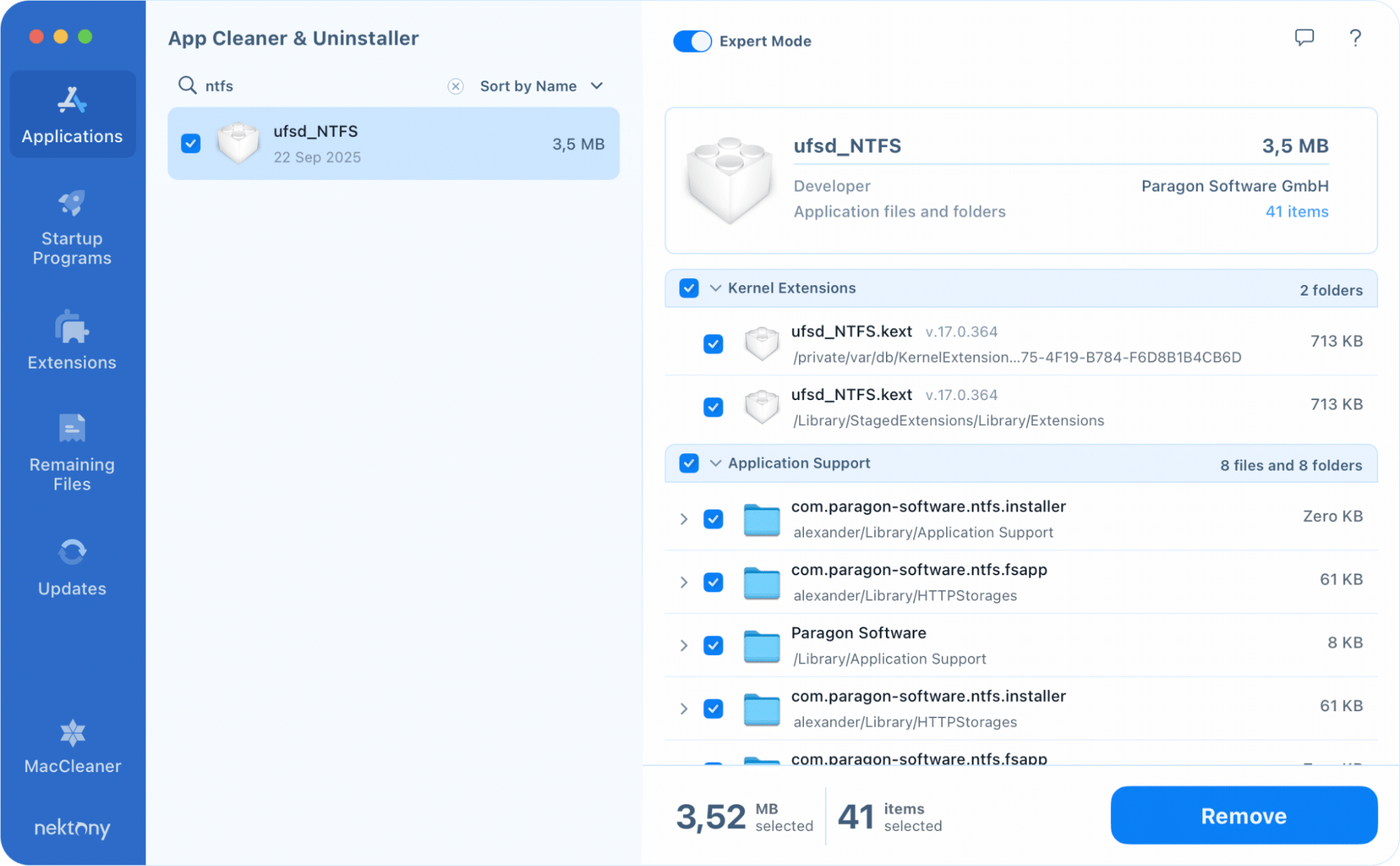
And if you have uninstalled the app earlier and now want to remove its leftovers, you can always find them in the Remaining Files tab.
Bottom line
Let’s be honest: an app like Paragon’s NTFS for Mac, which hooks deep into macOS, isn’t designed to be removed easily. It’s expected that it will plant files in system locations so protected that a simple drag-to-trash won’t even come close to removing it.
As we’ve seen, this is why the manual methods don’t make much sense here. You can spend 15 minutes on a digital scavenger hunt and, thanks to System Integrity Protection (SIP), you still won’t get a 100% result. You’re doing all the “nitty-gritty” work for an incomplete job.
This is where a dedicated tool just becomes the smart, logical choice. App Cleaner & Uninstaller gives you a clear dashboard of every single leftover file, even the protected .kext files that the other methods can’t properly manage. It lets you review them all and, if you ever decide to briefly disable SIP for a proper system purge, you can remove them all at once.
Frequently asked questions
What is the purpose of NTFS?
NTFS (New Technology File System) is the standard file system for Windows. By default, macOS can read these drives but cannot write to them. The purpose of Paragon NTFS is to act as a bridge (driver), allowing your Mac to fully create, edit, and delete files on NTFS-formatted drives.
Is exFAT or NTFS better for Mac?
For most Mac users, exFAT is the better choice. It is a universal format that works natively on both macOS and Windows without needing any third-party drivers or paid software. You should only stick with NTFS if you have a specific drive that must be used by a Windows system that requires NTFS features (like file permissions) that exFAT lacks.
Will uninstalling Paragon's NTFS for Mac delete any of my data on the external hard drive?
No, absolutely not. Uninstalling the Paragon NTFS driver from your Mac only removes the software from your computer. It does not touch, alter, or delete any of the data stored on your external hard drives. Your files will remain safe.
Should I delete NTFS for Mac?
Yes, if you no longer need to write files to Windows drives or if you are experiencing issues. Many users delete it because macOS updates frequently break the driver, requiring you to wait (and sometimes pay) for an update. If you rarely use Windows drives or can switch to a different format, removing it eliminates potential software conflicts.
What will happen to my external drives after I uninstall NTFS for Mac? Will my Mac still see them?
Your Mac will still see and recognize your NTFS drives. However, it will revert to its default, "read-only" behavior. This means you will be able to open and copy files from the NTFS drive to your Mac, but you will not be able to save, modify, or delete files on that drive.
Is it dangerous to leave ufsd_NTFS.kext on my Mac after uninstalling Paragon NTFS?
No, it is not "dangerous" in the sense that it will harm your hardware, but it is unnecessary system clutter. Keeping unused kernel extensions can potentially cause conflicts after future macOS updates, as these deep-level drivers often face compatibility issues with new system versions. If you no longer use them, it's best practice to remove them to keep your system clean and stable.
Why does my Mac still show Paragon NTFS even after I uninstalled it?
This happens because the standard uninstallation methods (moving to Trash or using the built-in uninstaller) are incomplete. They typically remove the main application but leave behind service files like com.paragon settings and the ufsd_NTFS kernel extension in hidden system folders like /Library/StagedExtensions/.