



June 5, 2026
How to uninstall Trend Micro Antivirus on Mac


Share


Trend Micro Antivirus does not disappear when you drag its icon to the Trash. The app installs system-level services, such as LaunchAgents, LaunchDaemons, a privileged helper, and a Safari extension, that keep running on every restart even after the main app is gone, and its menu bar icon usually comes right back on the next login.
~/Library
Copy
This Article Contains
Why you might need to remove Trend Micro Antivirus
Trend Micro is one of the heavier consumer antivirus suites on macOS. It runs background scans on file activity and network traffic, registers system extensions for endpoint security and network filtering, and installs a Safari content blocker. On older Macs or systems with sustained workloads, that overhead is noticeable because the app can also clash with developer tools, VPN clients, Docker, and Homebrew packages that touch low-level networking.
Apple has also tightened built-in macOS protections in macOS 13 through macOS 26, so a third-party antivirus is less essential for most home users than it was a few years ago. Add in the usual reasons like an expired subscription, an app you no longer use, or historical privacy concerns around Trend Micro consumer tools that MacRumors users flagged for sending system data without explicit consent, and a clean uninstall becomes the right move.
Manual vs. automatic uninstallation: a quick comparison
Trend Micro can be removed by hand or with a dedicated uninstaller. The table below shows how the two routes compare on a real test Mac.
| Criterion | Manual removal | App Cleaner & Uninstaller by Nektony |
|---|---|---|
| Number of steps | 20+ across Applications, /Library, ~/Library, and System Settings | 3 (find, select, remove) |
| Time required | 15–25 minutes | Under one minute |
| Technical knowledge | Comfortable with Finder paths, hidden files, and admin password prompts | None (components are grouped by bundle ID) |
| Risk of deleting the wrong file | High /Library and /Library/LaunchDaemons hold files from many apps |
Low only files matching com.trendmicro.* are touched |
| Completeness | Depends on user diligence; easy to miss WebKit, HTTPStorages, and Application Scripts caches | Detects every Trend Micro component, including hidden containers |
| Admin password needed | Yes | Yes (one prompt for the bundle) |
If you only want Trend Micro gone, jump to Method 3 and let App Cleaner & Uninstaller handle every component in a single pass. If you prefer the official Trend Micro tooling, Methods 1 and 2 below walk through both first-party options in full.
Method 1: How to uninstall Trend Micro manually
The manual route works on every recent macOS version (13 Ventura, 14 Sonoma, 15 Sequoia, and 26 Tahoe) and on both Intel and Apple Silicon. Before you start, save your Trend Micro serial number in case you need to reinstall later, and confirm you have the admin password for your Mac.
Versioning note: which Trend Micro do you actually have?
The Trend Micro name covers several different products, and the right uninstall path depends on which one is installed:
- Trend Micro Antivirus — the consumer product distributed from trendmicro.com; this guide focuses on this version.
- Trend Micro Antivirus One — a separate sandboxed App Store version; uninstall by dragging the app to Trash and removing files in .
~/Library/Containers/com.trendmicro.drsafety.*Copy
- Trend Micro Apex One Security Agent — an enterprise product managed by your IT team; removal usually requires an admin password issued by IT or the Common Uninstall Tool (CUT) from the VisionOne portal.
- Trend Micro Internet Security — an older suite; look for leftovers in .
~/Library/Containers/com.trendmicro.DrSafetyCopy
To check which one is installed, open /Applications/ in Finder and inspect the Trend Micro folder — the bundles inside reveal the edition.
Stop Trend Micro background processes
Trend Micro will block its own deletion if any of its services are still running. Click the Trend Micro icon in the menu bar and choose Shut Down Trend Micro Antivirus. If the menu bar icon is missing or the option is greyed out, force-quit the processes from Activity Monitor instead.
- Open Activity Monitor (Applications → Utilities → Activity Monitor).
- From the View menu, choose All Processes.
- Type in the search field at the top right.
trendCopy
- Select each Trend Micro process (look for ,
iCoreServiceCopy
,com.trendmicro.icore.esCopy
,com.trendmicro.icore.netfilterCopy
) and click the × button → Force Quit.AFMMainUICopy

Warning
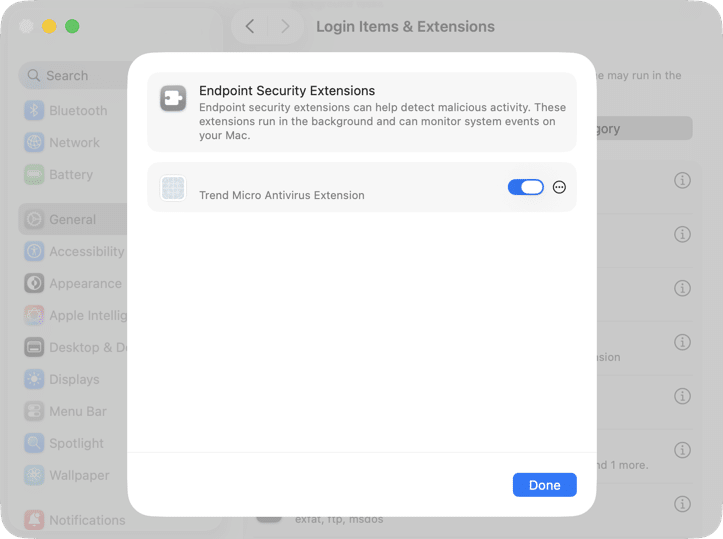
If a process refuses to quit and immediately restarts, a Trend Micro system extension is still active. Open System Settings → Privacy & Security → Network Extensions (and Endpoint Security Extensions) and revoke permission for any Trend Micro entry before trying again.
Use the built-in “Uninstall Trend Micro Antivirus” app
Trend Micro ships with its own uninstaller inside the application folder. It removes the main app and several support files, but it does not catch every leftover. My testing on macOS Tahoe showed 253 residual items (1.72 MB) remaining after the built-in uninstaller finished. Plan to do the leftover cleanup in the next subsection regardless.
- Open Finder → Applications, then open the Trend Micro folder.
- Launch Uninstall Trend Micro Antivirus.app.
- Click the Uninstall button on the welcome screen.
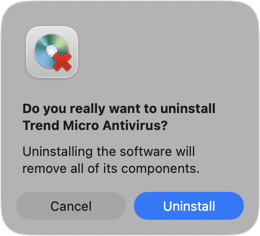
- Enter your Mac admin name and password when prompted, then click OK.
- Wait for the progress bar to finish — it usually takes 30–60 seconds.
- Click OK in the Uninstall completed dialog.
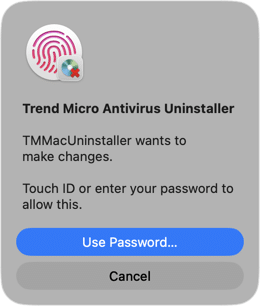
After the built-in uninstaller finishes, open System Settings → General → Login Items & Extensions and look under Endpoint Security Extensions and Network Extensions. Trend Micro extensions often remain registered with their toggles on, even when the main app is gone. Switch each one off, then click the three-dot menu → Delete Extension.

Open Safari and go to Safari → Settings → Extensions. If a Trend Micro Web Threat Protection extension is still listed, uncheck it and click Uninstall. The official Uninstall Tool (covered in Method 2) removes the Safari extension automatically, but the built-in uninstaller sometimes leaves it behind.

Find and remove leftover service files
Trend Micro scatters files across both the system-level /Library and your user-level ~/Library. These folders hold files from many other apps too, so move carefully and only delete items whose name contains TrendMicro, trendmicro, or com.trendmicro.
Pro Tip: Run a quick sanity scan from Terminal first to see what is actually still on disk:
sudo find /Library ~/Library -iname “*trendmicro*” 2>/dev/null
Copy
In Finder, press ⌘+Shift+G to open the Go to Folder dialog. Paste each system path below in turn and move what it opens to the Trash. Each system path will trigger an admin password prompt:

/Applications/Trend Micro/Copy
/Library/Application Support/TrendMicro/Copy
/Library/Frameworks/iCoreClient.frameworkCopy
/Library/Frameworks/iCoreClientPb.frameworkCopy
/Library/Frameworks/TMAppCore.frameworkCopy
/Library/PrivilegedHelperTools/com.trendmicro.AFM.HelperToolCopy
/Library/LaunchAgents/com.trendmicro.itis.dca.plistCopy
/Library/LaunchAgents/com.trendmicro.itis.dmr.plistCopy
/Library/LaunchAgents/com.trendmicro.itis.uimgmt.agent.plistCopy
/Library/LaunchDaemons/com.trendmicro.AFM.HelperTool.plistCopy
/Library/LaunchDaemons/com.trendmicro.icore.av.plistCopy
/Library/LaunchDaemons/com.trendmicro.icore.main.plistCopy
/Library/LaunchDaemons/com.trendmicro.icore.misc.plistCopy
/Library/LaunchDaemons/com.trendmicro.icore.wp.plistCopy
/Library/LaunchDaemons/com.trendmicro.itis.kext.plistCopy
/private/var/log/TrendMicroCopy
/Users/Shared/TrendMicroCopy

Now switch to the user-level paths. Reveal hidden files in Finder with ⌘+Shift+. (period), then repeat the same Go to Folder routine for each item:
~/Library/Application Scripts/com.trendmicro.AFMMainUI.AFMFinderSyncCopy
~/Library/Application Scripts/com.trendmicro.itis.SafariToolbarCopy
~/Library/Application Scripts/com.trendmicro.itis.SafariToolbar.ExtensionCopy
~/Library/Caches/com.trendmicro.AFMMainUICopy
~/Library/Caches/com.trendmicro.iTIS.PackageSelectorCopy
~/Library/Containers/com.trendmicro.AFMMainUI.AFMFinderSyncCopy
~/Library/Containers/com.trendmicro.itis.SafariToolbarCopy
~/Library/Containers/com.trendmicro.itis.SafariToolbar.ExtensionCopy
~/Library/HTTPStorages/com.trendmicro.AFMMainUICopy
~/Library/HTTPStorages/com.trendmicro.iTIS.PackageSelectorCopy
~/Library/Logs/TrendMicroCopy
~/Library/Preferences/com.trendmicro.AFMMainUI.plistCopy
~/Library/WebKit/com.trendmicro.AFMMainUICopy
Note:
~/Library
Copy
Finish with Finder → Empty Trash, then restart your Mac. The restart is the only reliable way to unload Trend Micro system extensions that were active during the cleanup.
Method 2: Use the official developer Uninstall Tool
Trend Micro publishes a standalone uninstaller as UninstallTool.zip for cases where the built-in route fails: the Trend Micro folder is already gone from Applications, the menu bar app refuses to quit, the consumer uninstaller throws an error, or an enterprise edition (Apex One) is installed.
Download the archive from the Trend Micro Help Center page that documents the uninstall procedure. The tool is a Universal Binary that runs natively on both Intel and Apple Silicon, and it has been confirmed to work on macOS 12 Monterey through macOS 26 Tahoe.
- Download UninstallTool.zip from the Trend Micro Help Center.
- Double-click the archive in Finder to extract UninstallTool.app.
- Right-click UninstallTool.app and choose Open (this avoids a Gatekeeper warning on first run).
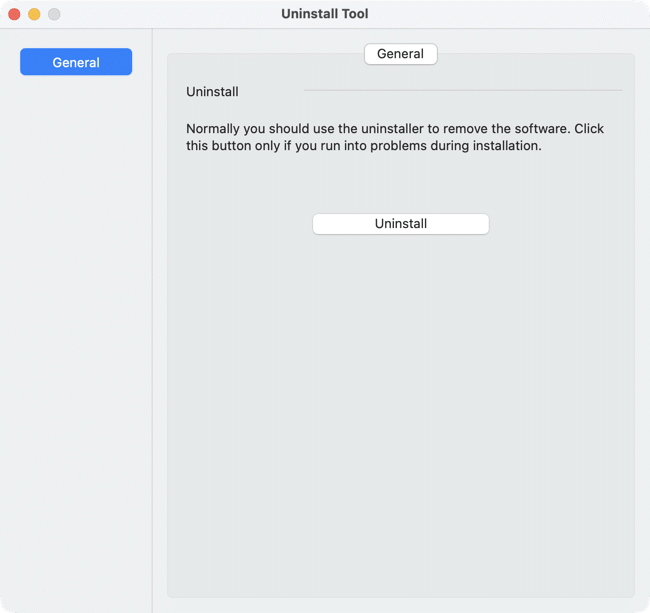
- Tick the I have copied my serial number checkbox so the Uninstall button activates.
- Click Uninstall, then enter your admin name and password when prompted.
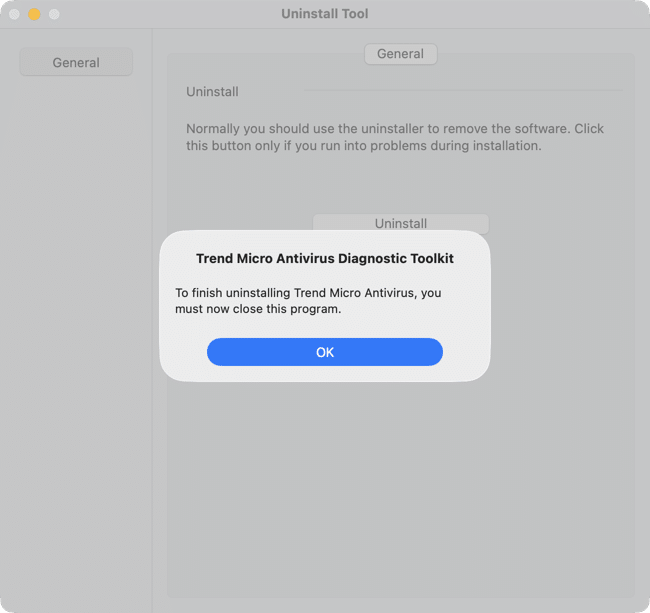
- Wait for the progress dialog to finish — it usually takes one to two minutes — and click OK.
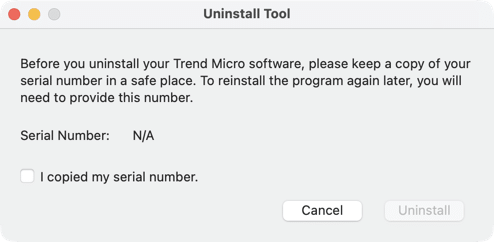
On my Mac, the standalone Uninstall Tool removed Trend Micro components more thoroughly than the built-in uninstaller; the Safari extension was gone automatically, and the registered system extensions were properly deregistered.
Note:
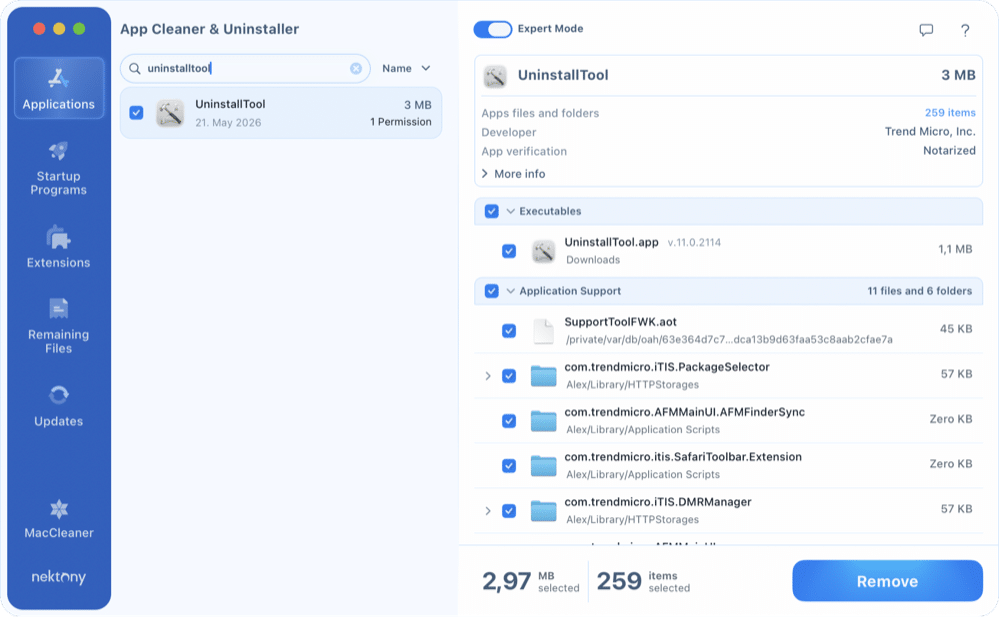
The standalone tool has a quirk worth knowing about. In my May 2026 testing, after running it the Remaining Files view in App Cleaner & Uninstaller showed zero Trend Micro entries — but only because all 259 leftover items (2.97 MB) were reattributed to UninstallTool.app itself, not actually deleted. Two new preference paths also appeared:
~/Library/Preferences/com.trendmicro.iTIS.UninstallTool.plist
Copy
/private/var/folders/…/C/com.trendmicro.iTIS.UninstallTool
Copy
Method 3: Uninstall Trend Micro automatically with App Cleaner & Uninstaller
If you would rather skip the path-by-path cleanup, App Cleaner & Uninstaller by Nektony detects every component that matches the com.trendmicro.* bundle identifier (including hidden containers, WebKit caches, and Application Scripts) and removes them in a single confirmed action.
- Download and launch App Cleaner & Uninstaller by Nektony.
- Select Applications in the left sidebar.

- Find Trend Micro Antivirus in the list. The app automatically groups every related component under one entry.

- Switch on Expert Mode (top toolbar) if you would like to have every component to be visible. In this case, tick the boxes next to every Trend Micro item.

- Click Remove (or Uninstall, if you’re not in Expert Mode) in the bottom right.
- Review the file list in the confirmation dialog and click Remove again to confirm.
- Enter your admin password if prompted.

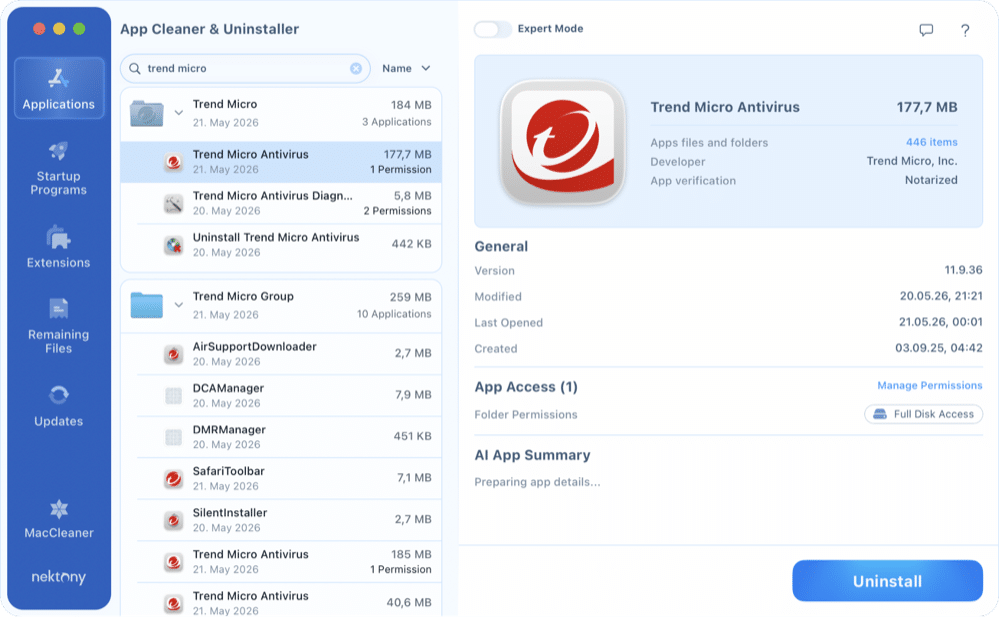
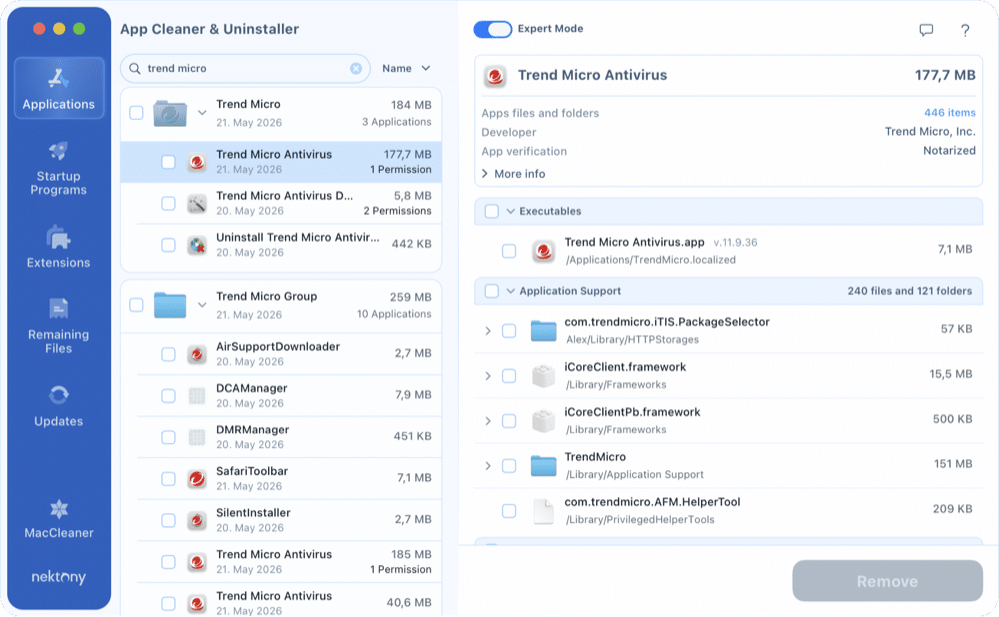
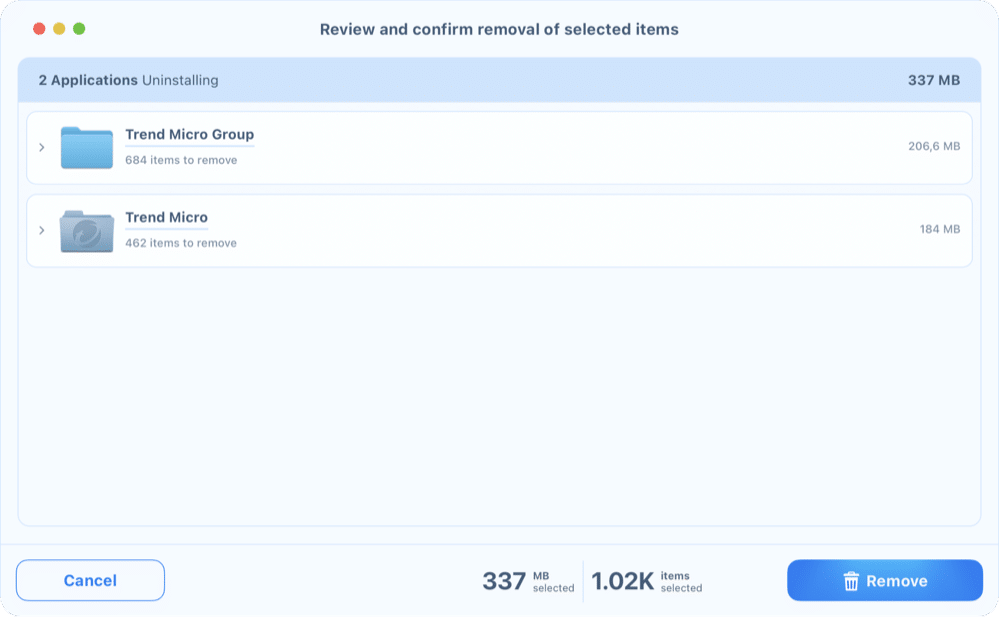
After the removal finishes, open the Remaining Files section in the sidebar and scroll for any entry that still mentions Trend Micro. There should not be one. If something appears, tick it and remove it the same way.
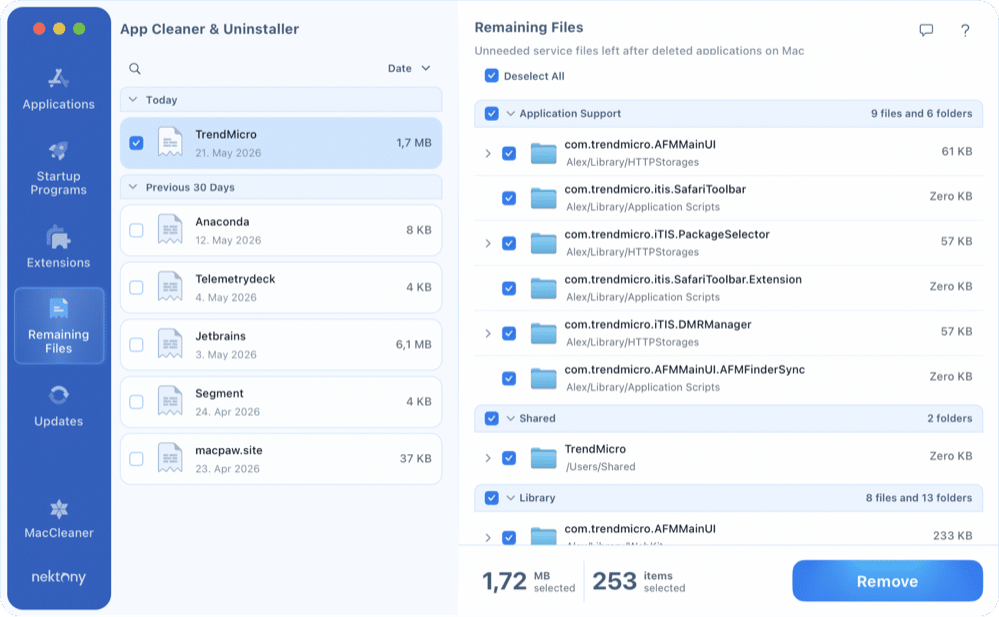
Empty the Trash and restart your Mac to unload any Trend Micro extension that was still active during cleanup. As a final check, open System Settings → General → Login Items & Extensions and confirm no Trend Micro entries remain under Endpoint Security Extensions or Network Extensions.
The bottom line
For the fastest clean removal, use App Cleaner & Uninstaller. It covers every Trend Micro component in one confirmed step, and it is the only one of the three methods that catches every WebKit cache, container, and Application Scripts folder without manual path hunting.
If you want to stay on first-party tools, run the built-in Uninstall Trend Micro Antivirus.app first; switch to the standalone UninstallTool.zip only when the built-in app is missing or fails. Plan for a manual sweep of ~/Library afterwards in both cases.
Whichever method you pick, finish by restarting your Mac and checking System Settings → General → Login Items & Extensions for orphaned Trend Micro permissions. And remember: uninstalling the app does not cancel your subscription; sign in at account.trendmicro.com to manage billing separately.

Frequently asked questions
How do I completely uninstall Trend Micro Antivirus from my Mac?
/Applications/Trend Micro/
Copy
/Library/Application Support
Copy
/Library/LaunchAgents, /Library/LaunchDaemons
Copy
~/Library/Caches
Copy
~/Library/Containers
Copy
~/Library/Preferences
Copy
Why does Trend Micro still appear in the menu bar after I deleted the app?
/Library/LaunchAgents
Copy
/Library/LaunchDaemons
Copy
How do I uninstall Trend Micro without an admin password?
You cannot. Both the built-in uninstaller and the standalone Uninstall Tool need admin credentials to remove the privileged helper, LaunchDaemons, and system extensions Trend Micro installed. On a personal Mac, run the uninstall from the admin account. On a managed Mac where you do not have the admin password (typical for enterprise Apex One installs), contact your IT team — Apex One specifically requires either the corporate password or the Common Uninstall Tool (CUT) from the VisionOne portal.
Does deleting Trend Micro cancel my subscription?
No. Uninstalling the app only removes the software from your Mac. Billing keeps running through either the App Store (for App Store editions) or your Trend Micro account. To stop charges, sign in at account.trendmicro.com and cancel the subscription there, or manage it in App Store → Account → Subscriptions on Mac if you bought it that way.
Will Trend Micro leave leftover files after its own uninstaller runs?
~/Library/HTTPStorages
Copy
~/Library/WebKit
Copy
~/Library/Application Scripts
Copy
/Users/Shared/TrendMicro
Copy
How do I uninstall Trend Micro if I cannot find the uninstaller app?
If /Applications/Trend Micro/ is missing or no longer contains Uninstall Trend Micro Antivirus.app — often because someone tried to delete the app by dragging it to Trash — download the standalone Uninstall Tool from the Trend Micro Help Center and follow Method 2. Alternatively, App Cleaner & Uninstaller can detect and remove every Trend Micro component even when the main bundle is gone.
Is Trend Micro Antivirus compatible with macOS Sequoia and Tahoe?
Yes, current Trend Micro Antivirus builds support macOS 15 Sequoia and macOS 26 Tahoe. Older installations sometimes fail to uninstall cleanly on newer macOS versions because their helper tools predate System Integrity Protection changes — update Trend Micro to the latest version before uninstalling whenever possible. The standalone Uninstall Tool covered in Method 2 also works as a fallback on these macOS versions, since it ships as a Universal Binary that runs natively on Apple Silicon.