

January 14, 2026
How to merge folders on Mac without losing data


Share


We’ve all been there. You are trying to organize your external drive or consolidate your backups, and you find yourself with two folders named “Work Projects” – one on your desktop and one on your USB stick. You don’t want to replace one with the other; you just want to combine them so that every unique file ends up in one safe place.
While macOS makes dragging and dropping easy, true “merging” requires a specific trick to ensure you don’t accidentally overwrite your data.
Whether you are tidying up scattered photo libraries or organizing documents on your Mac, this guide will show you how to combine your folders safely and efficiently.
This Article Contains
There’s an app for that!

How to merge folders using Finder
Note:
This guide was tested on macOS Tahoe. If you are using an older version, the steps remain the same.
For most quick organization tasks, Finder is the first place to look and is Apple’s official way to merge folders. However, you need to be careful. By default, if you drag a folder named “Archive” into a location that already has a folder named “Archive,” macOS will ask if you want to Replace it.
Note:
Do not click Replace unless you are 100% sure. Replacing deletes the original destination folder and all its contents before moving the new one. To combine them instead, you need to use a special trick.

How to add the Merge option (the file number difference trick)
To make the Merge button appear next to Replace in the dialog above, follow this guide.
- Open two Finder windows: one with your source folder and one with your destination folder.
- Ensure both folders have the exact same name, and the source folder has fewer files than the target folder.
- Drag the source folder to the other Finder window.
- When you release the mouse, a dialog box will appear. If it says “Stop,” “Replace,” and “Merge,” click Merge.

Here’s the animated GIF with me merging two folders:

Important limitations:
- The Merge button may not appear: This feature is notoriously finicky. It might not trigger if the folders have different creation dates or if the system views them as completely different types of directories. That has led to numerous complaints on Apple discussions about this particular feature.
- Duplicate handling: Finder’s merge is blind. If files have the same name, it may overwrite the old version with the new one without showing you the difference.
- Locked files: If you can’t edit some of the files in the folders you’re trying to merge, the merge operation will skip them.
- Cloud merge: If you’re performing the merge operation in the cloud drive folders (Google Drive, iCloud, Dropbox, etc.), potential sync problems and conflicting copies might occur.
- Free space: If the merge operation will lead to your Mac running out of free space, the merge operation won’t be complete.
How to merge folders using Terminal
Note:
Terminal commands are powerful. One typo can lead to permanent data loss. It is always a good practice to back up your data before proceeding.
ditto
Copy
- Open Terminal (Applications → Utilities → Terminal).
- Type the command followed by a space.
dittoCopy
- Drag your Source Folder into the Terminal window. The path will appear automatically.
- Type a space.
- Drag your Destination Folder into the Terminal window.

- Press Return.

Terminal will copy the contents of the source into the destination. It will preserve metadata and overwrite files in the destination if they have the same name as files in the source.
Also, see the important limitations for the Finder method: they mostly apply to the Terminal method as well.
The safest way to merge folders and remove duplicates
The previous two methods have one major caveat: blindly overwriting files is stressful. If you would rather not play “digital roulette” with your data, there is a smarter way to handle this.
Duplicate File Finder allows you to merge folders while seeing exactly what is happening. Instead of guessing which “Report.docx” is the newest one, this tool shows you the differences and handles duplicates for you.
How to use the “Merge & Organize” feature:
- Download and launch Duplicate File Finder.
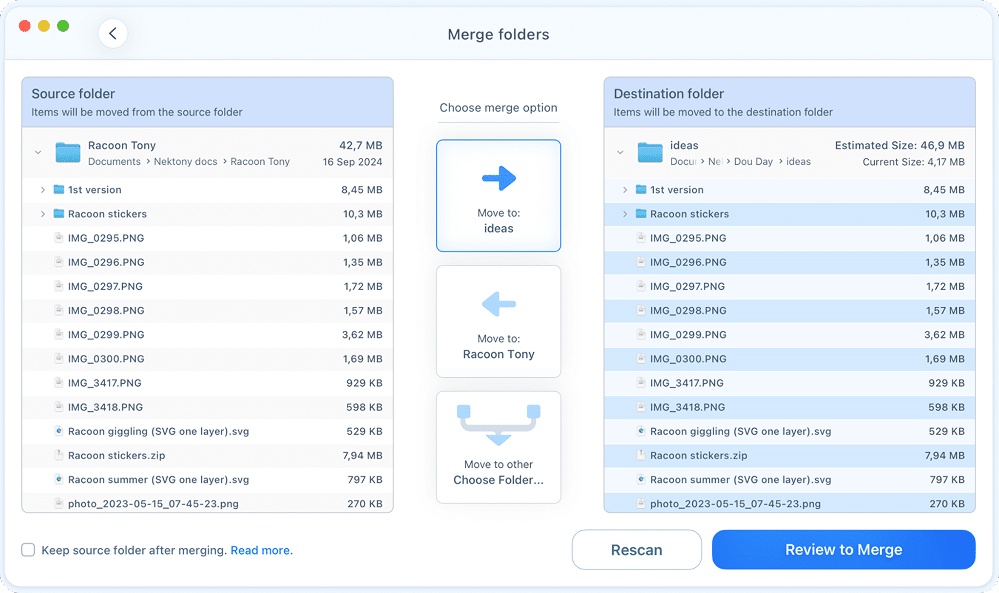
- Select Merge Folders on the left tab.
- Add the folders you want to merge.
- Click Review.

- You will see a visual list of unique files (files present in one folder but not the other) and duplicates.
- Click Review to Merge and then confirm your intentions.

You can also go the other, more robust way:
- Open Duplicate File Finder.
- Click Find duplicates on your Mac.
- Once the procedure is done, you’ll see the scan results.
- Click Similar folders on the left to spot the folders that you might want to merge.
- And you will also see the Merge multiple folders option on the left to do bulk merge.
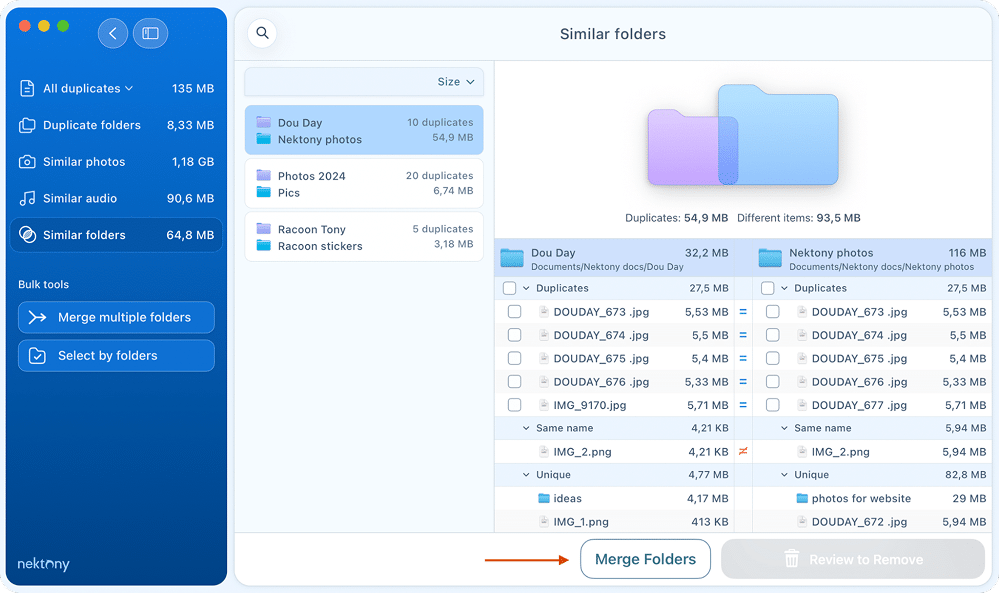
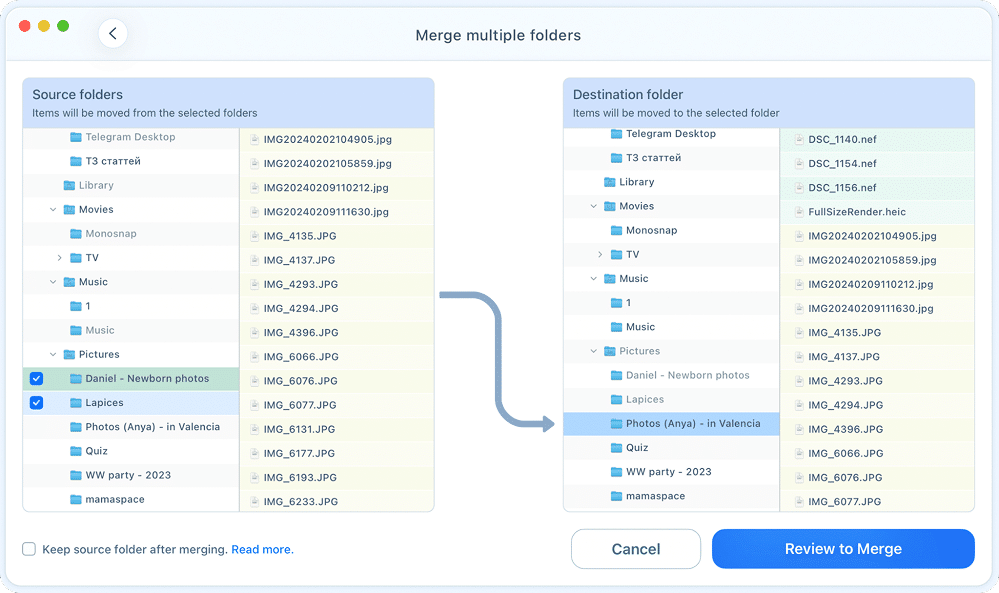
So yes, Duplicate File Finder can help you merge two folders, but it can also help you locate all similar folders and merge them in bulk if that’s what you are originally trying to achieve.
The bottom line
Back in the day, my backup strategy was pretty low-tech: I just dragged and dropped everything onto an external hard drive and hoped for the best. It felt safe at the time, but now that I actually have time to review those drives, I realize I created a bit of a monster.
I have backups of older backups, and somehow, some of those “old” folders contain files that are actually fresher than my “new” ones. Trying to untangle that web manually would be a massive headache. Honestly, I wouldn’t even attempt it if I didn’t have Duplicate File Finder. It handles the complex logic of merging those chaotic folders, so I don’t have to sit there comparing file dates one by one.
Whether you are fixing old backup mistakes like me or just organizing today’s work, the goal is the same: keeping your data safe without losing your mind.
Frequently asked questions
How do I force the merge option to appear in Finder?
The "Merge" button is hidden by default. To see it, you must press and hold the Option (⌥) key while dragging the folder to its new location. Note that this only works if both folders have the exact same name. If they are named "Photos" and "Photos 2," the option will not appear.
What happens to duplicate files when I merge folders?
If you use Finder, the system will ask if you want to replace the existing files with the new ones. It generally does not let you keep both or compare them side-by-side. If you need to manage duplicates intelligently (e.g., keeping the newest version), it is better to use a tool like Duplicate File Finder.
Can I merge folders using Terminal?
ditto
Copy
This command merges directory contents rather than replacing the directory itself. However, this is recommended only for advanced users, as a typing error can result in data loss.
Why did the 'Replace' button delete my files?
When you click Replace, macOS deletes the entire destination folder and its contents first, then copies the new folder into that empty space. It does not combine the contents.
How to merge multiple folders into one on Mac?
If you have several folders to combine (e.g., Folder A, Folder B, and Folder C), you can drag them one by one into a target folder using the Option key trick. For a faster method, you can use Duplicate File Finder to select multiple source folders and merge them into one destination in a single click.
How to combine documents together on Mac?
Merging folders collects all your files into one place. If you are trying to combine actual documents (like merging two PDF files into one PDF), you will need to use Preview or a PDF editor, not the folder merging method.
Can I merge Photos libraries on Mac?
Yes, you can merge Photos libraries directly within the Photos app on macOS.
For that:
- Open the Photos library you want to be your primary destination.
- In the menu bar, choose File → Import.
- Select the other library (the. photoslibrary file) you want to merge into the current one and click Review for Import.
- Click Import All New Photos to combine the entire contents.
Note: This method preserves edits and metadata, but it will transfer only the photos and videos (not your custom albums or folder structures).