

September 25, 2026
Uninstall apps on Mac: The guide with 6 ways to do it right in 2026


Share


Uninstalling apps on Mac is almost a whole science. The fact is, dragging an app to the Trash deletes only the icon. The app’s settings, logs, caches, login items, and helpers remain and add clutter, which may cause a storage problem over time. To avoid this, you’ve got a choice of six ways to finish the job, from one click to a full manual cleanup:
- App Cleaner & Uninstaller removes the app and every associated file and hidden directory automatically with one click, including items Finder never shows you.
- Built-in uninstaller comes in apps like Adobe, Microsoft 365, VPN clients, antivirus tools and is worth using to reach privileged helpers or extensions Finder can’t touch.
- Finder: Drag the app to Trash, empty it, then locate any remaining app files across the Library and delete them too.
- Launchpad: If you are on macOS 15 Sequoia or earlier, you can use it for apps that came from the Mac App Store.
- Terminal or Homebrew means using removal commands for all app service files, but note that this method bypasses Trash and does the uninstalling permanently.
Below is a full expose on each uninstallation method, why ‘delete’ and ‘uninstall’ aren’t the same thing on a Mac, what to do when an app flat-out refuses to go away, and whether you can remove Apple’s built-in apps at all.
This article contains:
Seconds to uninstall an app completely

Delete vs. uninstall: what’s the difference
macOS doesn’t have an uninstaller in the Windows sense. The first one has no central registry of installed software, and the latter tracks installers through the registry.
A Mac app is a self-contained bundle that also scatters files into your hidden Library folder and other system locations. Nothing on macOS logs where those files went, so finding them later means searching by app name or bundle ID, which is the part easy to miss.
This is the actual line between deleting an app and uninstalling it:
- Deleting removes the .app bundle, the single icon located in Applications.
- Uninstalling removes that bundle plus everything else it creates while running: preference files, cached data, saved application state, login items, and any launch agents or daemons it registered to run in the background.
Which uninstall method should you use
| Method | Removes leftovers | Risk of mistakes | Time | Best for |
|---|---|---|---|---|
| App Cleaner & Uninstaller | Yes | Low | < 1 min | Users who want to get rid of an app and its leftovers in a fast and reliable way |
| Built-in uninstaller | Most of them | Low | ~ 3‑5 min | Adobe, antivirus, VPN clients, Microsoft 365 |
| Drag and drop to Trash | No | Low | < 1 min | A quick app removal when you don’t care about leftovers |
| Finder | Depends on how thorough you are | Medium, easy to miss a folder | > 15 min | Users willing to spend 15+ minutes per app |
| Launchpad | No | Low | < 1 min | App Store apps on macOS 11 BigSur through 15 Sequoia |
| Terminal | Depends on how thorough you are | High, no way back | > 15 min | Pro users who know file paths and are good at commands |
What I measured: Before and after footprint
I picked three apps that behave differently on disk, logged the total footprint before removal, then ran each method and checked what remained on the drive afterward.
Test environment: macOS Tahoe 26.6.2, MacBook Pro, Apple M1, 8 GB RAM
Uninstalling Google Chrome Browser
| Removal method | Total footprint before | App removed | Associated files removed | Left behind (MB) | Result |
|---|---|---|---|---|---|
| Move to Trash | 7,66 GB | 702,6 MB | 702,6 MB | ~4,71 GB | Remnants left behind |
| Built‑in uninstaller | 7,66 GB | 702,6 MB | – | – | No built-on uninstaller |
| Terminal (rm -rf) | 7,66 GB | 702,6 MB | 7,7 GB | – | *If you know the exact paths, you can remove the whole thing |
| Finder | 7,66 GB | 702,6 MB | 5,4 GB | ~2,3 GB | Finder doesn’t find every path, so there’s a risk of missing items |
| App Cleaner & Uninstaller | 7,66 GB | 702,6 MB | 7,7 GB | – | Nothing left behind |
Uninstalling ProtonVPN
| Removal method | Total footprint before | App removed | Associated files removed | Left behind (MB) | Result |
|---|---|---|---|---|---|
| Move to Trash | 240,1 MB | 349,8 MB | 240,1 MB | 109,7 MB | Remnants left behind |
| Terminal (rm -rf) | 240,1 MB | 349,8 MB | 349,8 MB | – | *If you know the exact paths, you can remove the whole thing |
| Built‑in uninstaller | 240,1 MB | 349,8 MB | – | – | No built-on uninstaller |
| Finder | 240,1 MB | 349,8 MB | 345,9 MB | 3,9 MB | Finder doesn’t find every path, so there’s a risk of missing items |
| App Cleaner & Uninstaller | 240,1 MB | 349,8 MB | 349,8 MB | – | Nothing left behind |
Uninstalling Microsoft Word
| Removal method | Total footprint before | App removed | Associated files removed | Left behind (MB) | Result |
|---|---|---|---|---|---|
| Move to Trash | 2,91 GB | 2,74 GB | 2,74 GB | ~170 MB | Remnants left behind |
| Terminal (rm -rf) | 2,91 GB | 2,74 GB | 2,91 GB | – | *If you know the exact paths, you can remove the whole thing |
| Built‑in uninstaller | 2,91 GB | 2,74 GB | – | – | No built-on uninstaller |
| Finder | 2,91 GB | 2,74 GB | ~2,77 GB | ~140 MB | Finder doesn’t find every path, so there’s a risk of missing items |
| App Cleaner & Uninstaller | 2,91 GB | 2,74 GB | 2,91 GB | Nothing left behind |
Pre-uninstall steps
- Quit the app completely, including any menu bar icon or background processes. Use Activity Monitor if you’re not sure it’s fully closed.
- Cancel a subscription bought through the app. Uninstalling doesn’t touch billing, and it won’t delete documents you created either. The same principle applies to an account. Cancel it if you no longer need it.
- Back up exported settings or project files if you plan to reinstall later.
- Check System Settings → General → Login Items & Extensions for anything the app added to your startup list; leaving it there is a reason apps come back after removal.


Uninstall Mac apps automatically with uninstaller
App Cleaner & Uninstaller is the easiest way to uninstall apps on Mac completely in seconds. This tool saves time and avoids manual work, reducing the risk of missing files or deleting the wrong ones. Backed by a growing app database and years of active development, Nektony’s App Cleaner & Uninstaller:
- Identifies and groups all support files attached to relevant apps
- Shows every file linked to the app, so you can uncheck anything you want to keep
- Previews files before deletion, so you can confirm what’s leaving
- Leaves personal files and system folders untouched
- Moves removed files to the Trash by default
- Provides a batch-removal option
The whole process takes you a few clicks:
- Get and run App Cleaner & Uninstaller.
- Search for the app or find it in the list → select it.
- Click the Uninstall button.
- Preview the app files to be deleted → click Remove to finish.

Video guide: How to use the uninstaller
1:09

App Cleaner & Uninstaller checks against a database of over 20,000 known apps. It goes beyond uninstalling too:
- update apps across App Store, Sparkle, Electron, Squirrel, Homebrew, and GitHub,
- find and remove leftover files from apps you previously deleted the manual way,
- reset any app to its defaults,
- clear out cache and broken service files,
- manage startup items and extensions,
- check app Apple verification status,
- see app permissions and revoke any of them in one click,
- control network access by blocking Internet connection for any app.
Pros:
The quickest deep uninstallation
File preview before removal
Extra features: update apps, clear cache
Cons:
Short full-featured trial of 2 days
No removal after trial ends
Requires Full Disk Access
How to uninstall apps with their built-in uninstaller
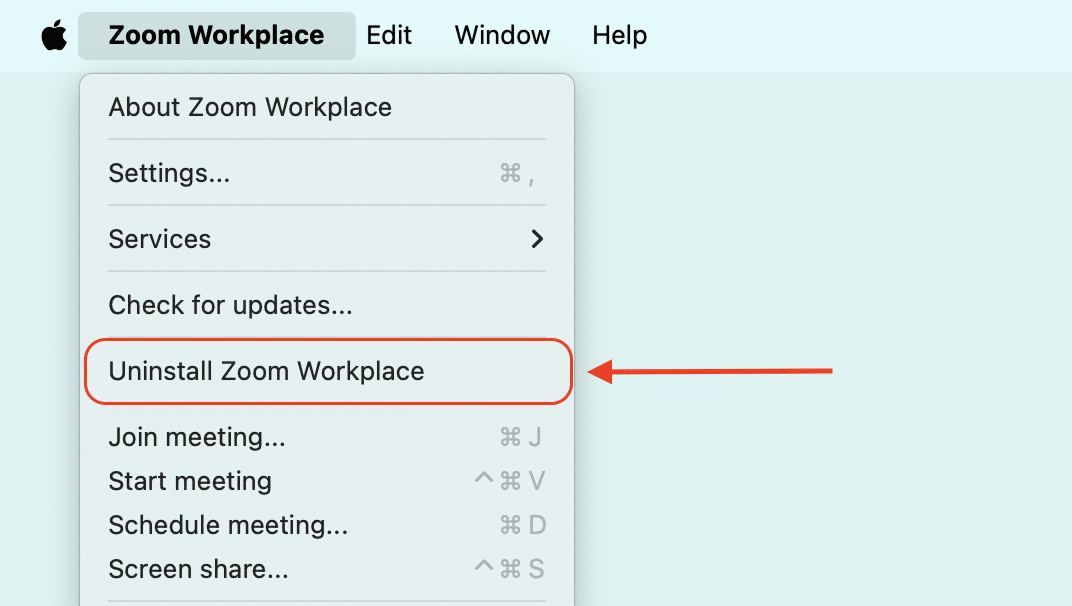
Some apps downloaded from developer websites provide an uninstaller. These apps can be antivirus tools, VPN clients, Adobe software, and other suites that install privileged helpers, system extensions, or background services Finder can’t remove.
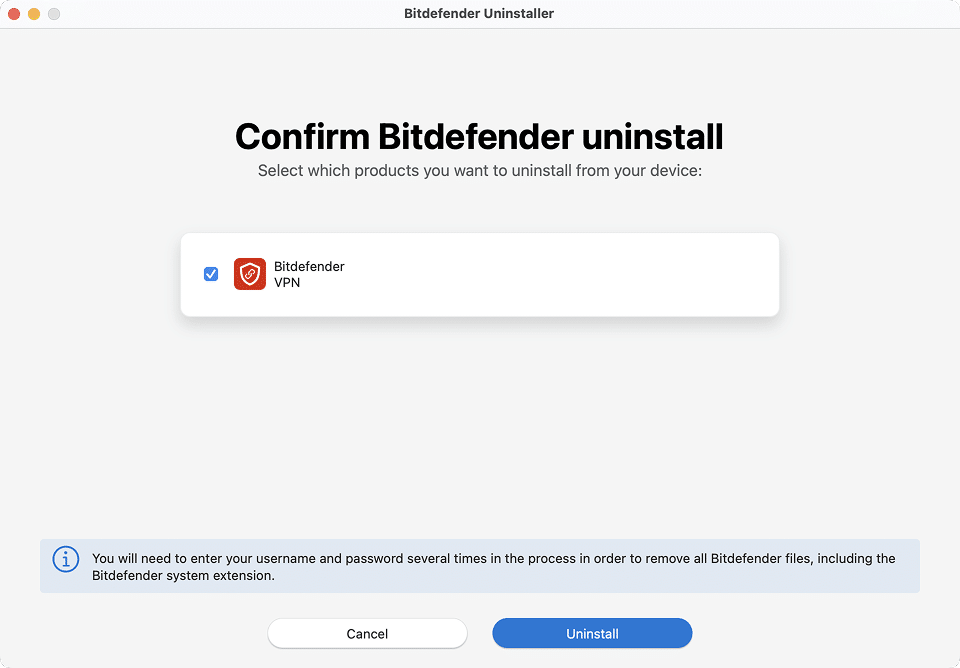
- A built-in uninstaller is typically findable next to the app in the Applications folder:
/Applications/<AppName>/Uninstall <AppName>.appCopy
- For some VPN clients, a script (that you run through Terminal with sudo) is available at:
/Applications/<VPN>.app/Contents/Resources/uninstall.shCopy
- You can also find the uninstaller in the top menu.

~/Library/Application Support
Copy
/private/var/
Copy
Pros:
No extra tool needed
Removes the pieces Finder can't
The safer route for antivirus and VPN tools
Cons:
Rarely removes everything
Not every app has one
Some VPN uninstallers run through Terminal
How to uninstall an app on Mac using Finder
This is the baseline method: it works the same on Intel and Apple Silicon, and on every macOS version from 10.14 through 26.
Note:
- The drawback is that Finder doesn’t show you hidden folders through a standard search.
- Try Command+Shift+G to open Go to Folder and jump to any directory.
- Or, to show hidden files or folders, use Command+Shift+.
Step 1: Quit the app. Press Cmd+Q, or check Activity Monitor for any processes.
Step 2: Move it to Trash. Open Finder → go to Applications → drag the app to Trash.
Cmd+Delete or right-click → Move to Trash both work the same way.
Step 3: Check for leftover files. Search by app name or bundle ID inside:
~/Library/Application Support/Copy
~/Library/Caches/Copy
~/Library/Preferences/Copy
~/Library/Saved Application State/Copy
~/Library/Containers/Copy
~/Library/Group Containers/Copy
/Library/LaunchAgentsCopy
/Library/LaunchDaemonsCopy
To reach each destination, use the Cmd +Shift + G shortcut and enter directories in the Go to Folder placeholder.


Step 4: Empty Trash. Without this step, the app is still physically on your disk.
Pros:
Free and built into macOS, no extra software
No special permissions needed
Works identically on any Mac, any macOS version
Cons:
No guarantee every leftover file gets found
Takes real time and effort
Risk of missing a folder or deleting the wrong one
If you’d rather not comb through the Library, let App Cleaner & Uninstaller handle it in one go.
How to delete apps with Launchpad on macOS Sequoia or earlier
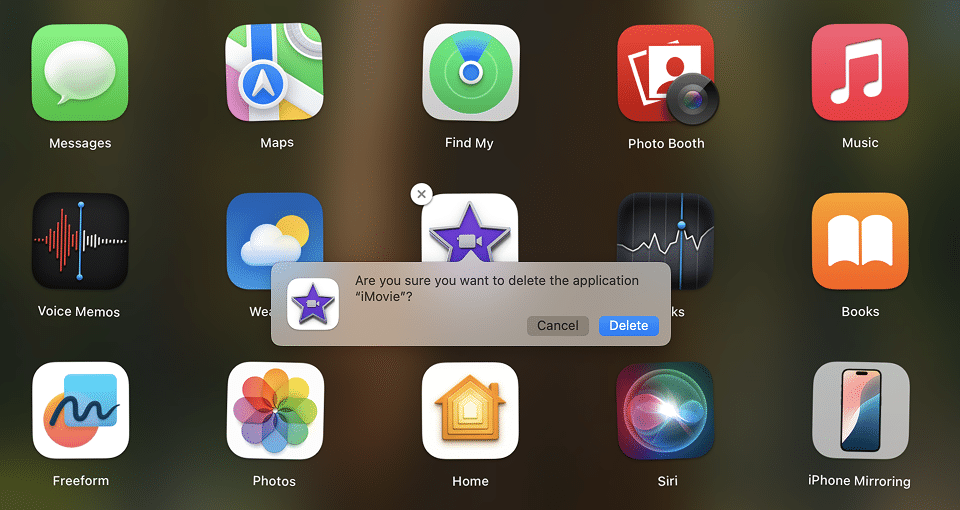
Launchpad’s jiggle-mode delete works on macOS 11 Big Sur through 15 Sequoia for the apps downloaded from the App Store. But this method is the same as dragging and dropping an app to Trash, which means it doesn’t remove all the support files associated with the app.
- Locate Launchpad in the Dock → open it.
- Hold the app icon or hold Option until the icons jiggle and the X button appears.
- Click the X and confirm.

Note:
- Your purchase, if any, stays tied to your Apple ID.
- You still have to locate and remove every app-related remaining file.
Pros:
Free and built into macOS, no extra software
No special permissions needed, works right from the Dock
Quick for App Store apps, no Finder navigating required
Cons:
Only works on macOS 15 Sequoia and earlier
Only removes App Store apps, no .dmg or .pkg support
Leaves the same leftover files as dragging to Trash
How to remove apps using Terminal
This method works if you’re confident with commands. Otherwise, it can be dangerous:
- There is no undo option or Trash to recover from; Terminal removes permanently.
- It needs the exact directory path; there is no room for guessing.
- Mistyped commands can accidentally remove the wrong files.
Note:
You can drag the app, its folder, or file from Finder straight into the Terminal window so it types the exact path for you.
Also, Terminal doesn’t save you from the leftover cleanup Finder requires. Still, you can uninstall an entire app with Terminal. Next, you’ll see command samples; replace App name, id, and bundle id with yours.
Step 1: Run Terminal (Applications → Utilities).
Step 2: Terminate all app processes with the following command:
pkill -f App nameCopy
Step 3: Remove the app’s main executable file:
sudo rm -rf “/Applications/AppName.app”Copy

~/Library
Copy
Step 4: Clear the app remnants.
- For .pkg installs, pkgutil handles the package record:
pkgutil --filesCopy
# This command shows what the package puts on disk, which is useful before you delete anything.
After you see the file list, remove them with the same command as in Step 3.
sudo pkgutil --forgetCopy
This command clears the receipt after the files are gone.
- For other installs, you have to be thorough in finding and removing all the app directories, e.g., Caches, Application Support, Preferences. For example, removal commands for the app leftovers look like this:
rm -rf ~/Library/Caches/rm -rf ~/Library/Application\ Support/ rm ~/Library/Preferences/ .plist Copy
Pros:
Free and built into macOS
Full control over exactly what gets removed
Gives direct access to every file on request
Cons:
No undo, no Trash to fall back on
Requires the exact directory path every time
Doesn't save you from finding leftovers yourself
How to uninstall apps with Homebrew
- For apps installed as Homebrew casks, use brew uninstall --cask:
brew uninstall --cask AppNameCopy
- For command-line tools and other Homebrew formulae, use:
brew uninstall AppNameCopy
Step 1: Open Terminal (Applications → Utilities).
Step 2: Check whether Homebrew knows the app or package:
brew list --caskCopy
For command-line packages, use:
brew list --formulaCopy
Step 3: Uninstall the app. For example, to remove Antigravity installed with Homebrew:
brew uninstall --cask antigravity-cliCopy

Homebrew removes the files it installed for that cask, but this doesn’t necessarily mean every file the app created while running is gone. App settings, caches, saved states, and other data in your Library may remain.
Note:
If you’re not sure what Homebrew installed, you can search its package list before removing anything. To see information about a cask before uninstalling it, you can also use:
brew info --cask AppNameCopy
Pros:
Convenient if you already use Homebrew to manage apps
Removes the Homebrew-installed app with one command
No need to manually locate app bundle
Cons:
Works only for apps installed through Homebrew
May leave app-created files in your Library
Same no-undo risk as Terminal
How leftover app files can affect your Mac
When your Mac’s available storage falls below 15-20%, system performance can slow down noticeably. Here’s how each type of leftover file impacts your Mac’s performance.
| Type of leftover file | Potential Impact |
|---|---|
| Preferences (.plist) | May load outdated settings or trigger errors if the app is reinstalled |
| Caches | Accumulate over time and use disk space |
| Application Support files | Store large data (e.g., project files, history) |
| Launch Agents / Daemons | May auto-run leftover services on startup |
| Saved States / Logs | Can bloat storage and slow app re-launch times |
Did you know?
According to Nektony’s internal insights, up to 80% of uninstalled apps leave behind residual files that can range from 500 MB to over 5 GB, depending on the app.
For example, uninstalling professional software like Adobe Creative Suite or Xcode can leave gigabytes of leftover data on your system unless you remove it completely.
Removing leftover files an app leaves behind
No matter which uninstall method you use, you may still have some app leftovers to deal with. The simplest thing you can do is to let a tool find and remove them for you.
Delete leftovers automatically with App Cleaner & Uninstaller
- Run App Cleaner & Uninstaller.
- Click the Remains tab in the Applications section.
- Select the items you’d like to remove.
- Click Remove → review the files to be removed → confirm removal.

What to do if an app won’t uninstall
Reason 1. An app is still running.
- Check Activity Monitor for the app or a background helper process and quit it before trying again.
- Alternatively, run in Terminal: .
ps aux | grep <AppName>Copy

Reason 2. A launch agent or daemon is holding on.
- To check, enter the following command in Terminal:
launchctl list | grepCopy
- Before deleting the file, unload it with:
launchctl bootout gui/$(id -u)/Copy
Reason 3. A file is locked.
- Run on the stubborn file to check for the
ls -lOCopy
flag.uchgCopy
- Clear it with .
sudo chflags nouchg <path>Copy
Reason 4. A system extension won’t let go.
This is common with VPN clients and antivirus software.
- Check System Settings → Privacy & Security for the extension and revoke its approval there.
- In stubborn cases, you may need to restart in Safe Mode. On Apple Silicon, fully removing a system extension can require confirming the change in Recovery Mode or Reduced Security Mode; Intel Macs allow some of this without a Recovery boot.
Reason 5. You have a second-hand or former work Mac with apps you can’t remove.
Check whether it’s still enrolled in a company’s Mobile Device Management (MDM) profile. MDM restrictions block removal by design, and only your IT department can lift them; there’s no user-side workaround.
Final way: How to uninstall an app on Mac
- Finder is fine if you have time and patience to hunt down each directory yourself.
- App Cleaner & Uninstaller does the uninstalling automatically, completely, and safely, including files from apps you’ve already tried to remove another way. Use it if you’re clearing space or want a clean switch with nothing left behind.
- Apps with built-in uninstaller should go through that first, since Finder can’t touch their privileged helpers anyway.
- Launchpad is usable on macOS up to Sequoia for App Store apps only.
- Save Terminal and Homebrew for cases where you already know the exact paths and accept the risk that comes with removal commands.
Hello, the design of your website is very beautiful and eye-catching. It is also very useful that it is mobile friendly.